 In response to my previously published commentary, Restaurateurs Offer Seal and Foie Gras Burger, Whine About “Animal-Rights ‘Extremists,'” a thoughtful acquaintance asked, rhetorically, “Why are people so ignorant?”
Coincidentally, I’d just come across a useful way of thinking about that question, which so many animal-rights advocates ask themselves, in one way, shape, or form, each and every day.
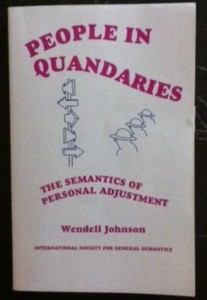
In his insightful People in Quandaries: The Semantics of Personal Adjustment (Harper & Brothers, 1946), Wendell Johnson wrote: “The psychiatrist, Dr. Adolf Meyer, of Johns Hopkins University, has said that what ails most people is not that they are ignorant but that they know too much that isn’t so.”
Johnson also observed, in People in Quandaries, that “the attempt to maintain old views and customs would appear more hazardous than the effort to understand and to take advantage of the powerful forces moving us in new directions.”
In my commentary about degenerate restaurateurs Kim Côté and Perle Morency, I quoted the National Post as reporting that “what Ms. Morency finds most frustrating is the lack of understanding of the seal hunt among the animal-rights ‘extremists.’ For one thing, the hunting of seal pups has been outlawed since 1987.”
And I pointed out that “Ms. Morency was quoted in the National Post report as saying, ‘The real debate is that there is a resource that is over-abundant at this time, and yet it is not accepted that this resource be exploited in a healthy, respectful way.'”
The “real debate,” Ms. Morency and her thoughtless ilk need to realize, is between those who believe that man is entitled to hold dominion over other species, and those who do not.
Clearly, Mss. Côté and Morency, like so many others, haven’t bothered to think compassionately for themselves, as evidenced by the latter’s lame attempt to rationalize not only her heinous behavior but that of so much of our shamefully anthropocentric society.
Perhaps asking ourselves, “Why are people so ignorant?” is a way of expressing our frustration with the fact that we’re debating a community of astonishingly unabashed rubes.
Which brings us to another instructive passage from People in Quandaries, in which Johnson wrote: “If a statement is such that those who hear it do not agree at all as to how it might be verified or refuted, the statement may be ‘beautiful’ or ‘eloquent,’ or grammatically irreproachable, but it is also, and above all, nonsense.”


Post a Comment